

The latest news from the State of Georgia
Provided by AGP
Mange and What It Means for the American Black Bear
By Carl Tugend/DWR and Katie Martin/DWR
Photos by Carl Tugend/DWR
There are many ways people view bears: as misunderstood neighbors, culturally significant, feared, respected, nuisance, dangerous, etc., but one thing I believe everyone can agree on is that they play an important role on our landscape, not only in Virginia but across the globe. Here in Virginia, we have only one of the eight species of bear, the American black bear. In North America, black bears are not only one of the most common and widely distributed bear species, but also one of the most studied mammals. This leads to a high level of knowledge about their life history and population characteristics, however, as we have learned, there is still much more to learn about them.
Black bear survival has been generally unaffected by parasites and diseases; human-related causes (hunter harvest, vehicle collisions, depredation permits, habitat destruction) are the main driver in adult bear mortality. But, over the last decade an emerging parasitic concern has emerged for bears, sarcoptic mange. Mange, a highly contagious skin disease caused by mites, affects many wild and domestic mammals. Sarcoptic mange caused by Sarcoptes scabiei is implicated most often in Virginia’s bears exhibiting signs of mange.
From 2014 to 2018, sporadic reports of bear mange in Virginia were primarily focused in the northern Shenandoah Valley. Since 2020, reports have increased in frequency and geographic spread. As of January 2026, there are 37 confirmed mange-positive counties in Virginia. There are many unknowns related to the occurrence and spread of mange in bears. Clinical signs can include itching, hair loss, thickened and dry skin, altered behavior, and poor body condition in severe cases. Research and experience have shown that many bears with mild to moderate cases can survive and clear symptoms of mange. There has been no clear evidence from other states with longer histories with sarcoptic mange that the disease limits populations over the long-term. However, localized population declines have been observed recently in some mange-affected areas of Virginia, particularly in counties with historically liberal harvest seasons.
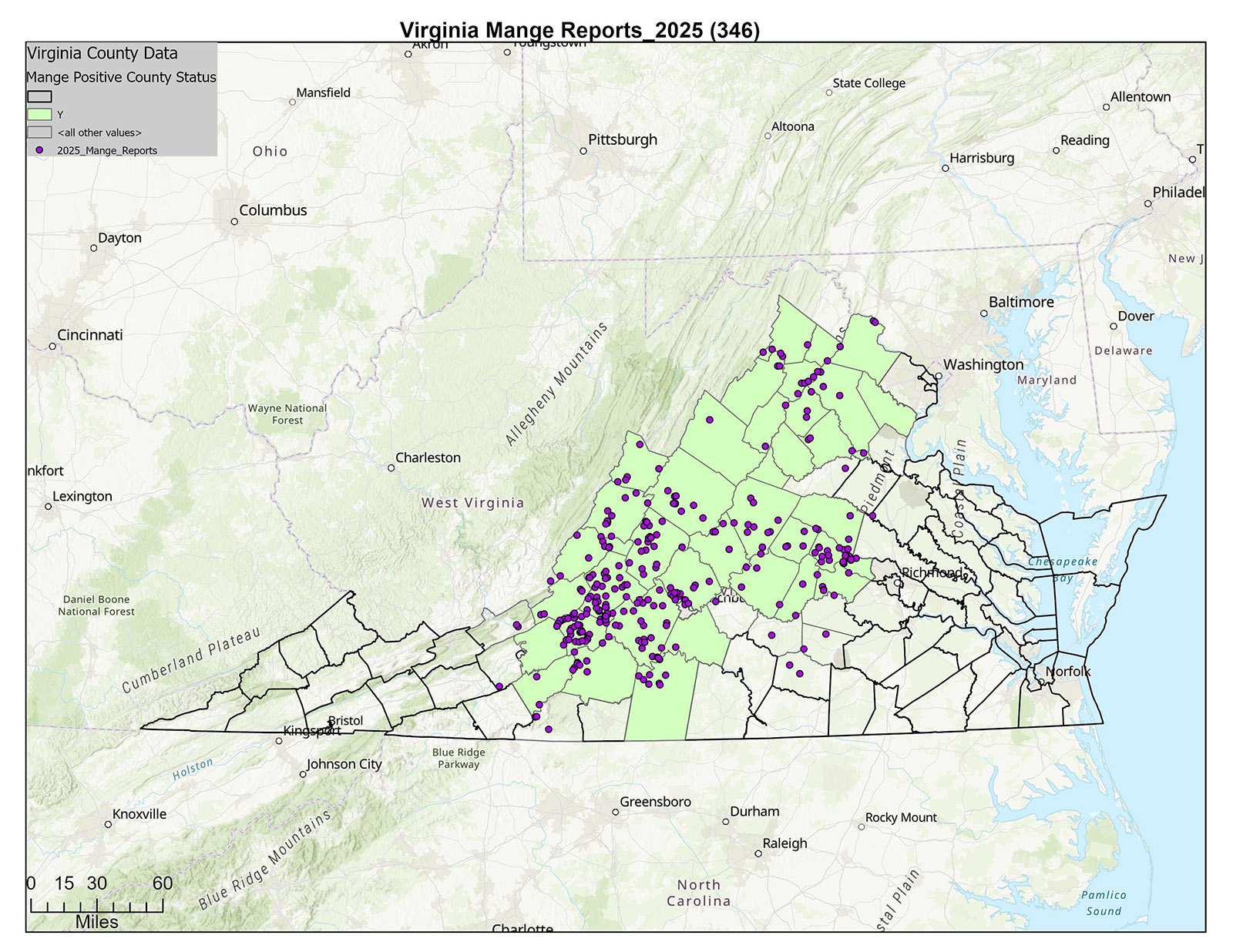
A lot of people ask the Virginia Department of Wildlife Resources (DWR) what is being done about this disease:
- A 2017 experimental treatment study done with The Wildlife Center of Virginia.
This study found that treatment can clear clinical signs, but it does not prevent reinfection, which in most cases was more severe. (A paper on this is currently being reviewed for publication.) Pennsylvania studied survival in treated versus untreated bears and found no significant difference, with 88 percent of bears surviving following treatment versus 74 percent in the untreated group. (Paper: Resolution of Clinical Signs of Sarcoptic Mange in American Black Bears (Ursus americanus), in Ivermectin-Treated and Nontreated Individuals).
- USDA-WS Conflict Helpline helps to track disease prevalence and spread through public reporting.
Reports to the USDA-WS Wildlife Conflict Hotline (855-571-9003 or email vawildlifeconflict@usda.gov) help us to track the prevalence of this disease in the areas where it has become established, along with tracking the speed and direction of spread. This information is utilized to help us target areas for education and outreach, form management actions, and pick study sites for research projects.
- In 2022 Virginia hosted the first mange-specific meeting with 22 other states in attendance and numerous other partners including the National Park Service, the Southeast Cooperative Wildlife Disease Study (University of Georgia), and Penn State University.
This meeting brought mange to the forefront of discussion topics across multiple agencies. It helped to develop multi-state research projects, which are still ongoing today. It allows states to standardize data in order to easily share it with other managers.
- In 2025, Virginia developed and adopted a Bear Mange Management Plan.
This plan helps to standardize our approach to studying and managing bears with mange on the landscape. This plan acts as a strategic reference to help guide our management approach without limiting us to specific actions.
- During 2024 and 2025, DWR developed additional ways the public could help learn more about this disease to better manage our bear population.
In 2024 DWR staff ran voluntary sample collection stations across the mange-endemic area. This was established for hunters to bring the bears they harvested to a station in order to be sampled. This provided additional opportunities to sample healthy bears in the mange area in order to have comparisons to our mange samples, hopefully giving us insight into why some bears contract mange while others may not. In 2025, we provided hunters with a hunter log in order to track bear sightings and condition along with sample kits for hunters to utilize through the season. The hunter log will continue to bolster population data in these areas, while the sample kits provide us with a more robust sample set strengthening the result and outcomes.
- Research during 2022 through 2026.
DWR has been involved in numerous mange research projects both with Virginia partners and external partners. These projects include Bear Mite Burden (multi-state), Mange Toxicology (multi-state), Bear Mange Microbiome Study (muti-state), Genetic Health Marker Testing in Mange Bears (multi-state), Human Dimensions of Mange Management (multi-state), and Population and Demographic Impacts of Sarcoptic Mange on Virginia Black Bears and Implications on Harvest Season Structure based on Predictive Densities in Mange and Non-Mange Affected Areas (Virginia Tech).
There are still a lot of unknowns about this disease, but through cooperation, partnerships, and research we have started to get a better understanding of the affect mange has on the American black bear. We will continue to utilize every resource we can to make sure our management is effective at keeping this landmark species at viable numbers and as healthy of a population as we can with a disease such as this one on the landscape.
For more information on bears in Virginia and bear mange, visit the black bear section of the DWR website.
To report a bear with suspected mange please call the tollfree USDA-WS Conflict Helpline (855-571-9003) or email vawildlifeconflict@usda.gov.
Carl Tugend is the DWR Black Bear Project Leader and Katie Martin is the DWR Deer/Bear/Turkey Biologist.
Legal Disclaimer:
EIN Presswire provides this news content "as is" without warranty of any kind. We do not accept any responsibility or liability for the accuracy, content, images, videos, licenses, completeness, legality, or reliability of the information contained in this article. If you have any complaints or copyright issues related to this article, kindly contact the author above.
